

Discogs is the most information-dense marketplace a small seller will ever work in. Buyers there know more about the object than you do. They know which pressing has the wider spine, which catalog number denotes the German repress, and exactly what Very Good Plus is supposed to sound like. That is either a burden or an enormous advantage, depending entirely on how carefully you set up.
This guide covers the setup, the two skills that determine your reputation, and the operational problem that catches almost every record seller eventually.
Setting Up a Seller Account
Discogs requires a payment profile and a seller agreement before you can list, and it applies a minimum feedback and account standing requirement in some regions. Get that out of the way first, along with two things new sellers routinely leave blank:
Shipping policies. Discogs lets you define shipping by region and by number of items. Configure this properly on day one. Records are heavy, awkward, and expensive to ship badly, and a shipping policy that undercharges for a two-LP set is a mistake you’ll repeat on every order until you fix it. If you’re willing to ship internationally, say so explicitly and price it honestly — international shipping policy is worth thinking through in detail before you turn it on rather than after your first order to Japan.
Your seller terms. Write out how you pack, how fast you ship, and what your return stance is. Discogs buyers read this. A clear, specific terms block does more for buyer confidence than any amount of marketing language.
The First Real Skill: Matching the Right Release
Every Discogs listing attaches to a specific release in the database — not the album, the release. The 1984 US original, the 1984 European pressing, the 2015 remaster, and the 2021 colored-vinyl reissue are four different entries with four different prices.
Matching to the wrong one is the most common beginner error, and it’s uniquely damaging because it looks like fraud from the buyer’s side. Someone paid original-pressing money and received a reissue. Even if it was an honest mistake, that’s a refund and a mark on your record.
How to match correctly:
- Use the runout matrix. The etched text in the dead wax is the most reliable identifier for a pressing, and Discogs release pages list it. Read yours, compare it, and don’t approximate.
- Check the catalog number on the spine and label. Same album, different catalog number, different release.
- Check the label variation. Rim text, logo style, and address lines on the label distinguish pressings that are otherwise identical.
- When in doubt, match to the least specific accurate entry rather than guessing at a valuable one. Underclaiming costs you a few dollars. Overclaiming costs you a dispute.
If your copy genuinely doesn’t match anything in the database, submit it. The database improving is how Discogs works, and sellers who contribute get better at identification faster than sellers who don’t.
The Second Real Skill: Grading Honestly
Discogs uses the Goldmine standard, and grading is the single largest driver of your feedback score. Two rules cover ninety percent of it.
Grade the media and the sleeve separately, and grade the worst thing you can find. A record with one deep scratch is not Very Good Plus because the rest of the surface is clean. Buyers grade the flaw, not the average.
Play-grade anything you’re not certain about, and say when you have. “VG+ (play-graded, light surface noise on side A track 1)” is enormously more valuable to a buyer than “VG+” alone. It tells them you actually listened, and it sets a specific expectation you can point to if they complain.
The temptation to grade generously is real, because a grade higher is worth real money on a scarce title. Resist it. Discogs buyers are repeat buyers who develop opinions about specific sellers, and a reputation for optimistic grading follows you permanently. We’ve written in more depth about the grading mistakes that quietly kill a seller’s sales, and it’s worth reading before you grade your first hundred records, because grading habits are very hard to change once formed.
One specific case worth flagging: sealed records. “Still Sealed” is not a grade — it’s a claim about a package you haven’t opened, and it can hide seam splits, warps, and drilled cutouts. Note anything visible on the shrink, and price accordingly.
Pricing Against Real Data
Discogs shows you the last sold price, the median, the low, and the high for every release. This is far better data than most marketplaces give sellers, and it is still easy to misuse.
The median is a statistic about a set of past sales, not a prediction about your copy. It blends conditions, pressings sold under the same entry, and sales from years apart. A median of $40 on a release where nearly all sales were Near Mint doesn’t mean your Very Good copy is worth $40 — and it may not mean it’s worth $30 either, because condition-sensitive buyers may not want it at any price they’d consider reasonable.
Read the actual sales history: what condition sold, at what price, how recently, and how often. A record that sells twice a year and a record that sells twice a week want completely different pricing strategies. We go deeper into that distinction in our piece on median versus real market price.
Then account for fees and shipping before you commit. The Discogs fee calculator will tell you what actually lands in your account on a given sale price.
Listing Efficiently
Discogs listings are fast once you’ve matched the release — the metadata is already there, which is why record sellers can build large inventories much faster than sellers on general marketplaces.
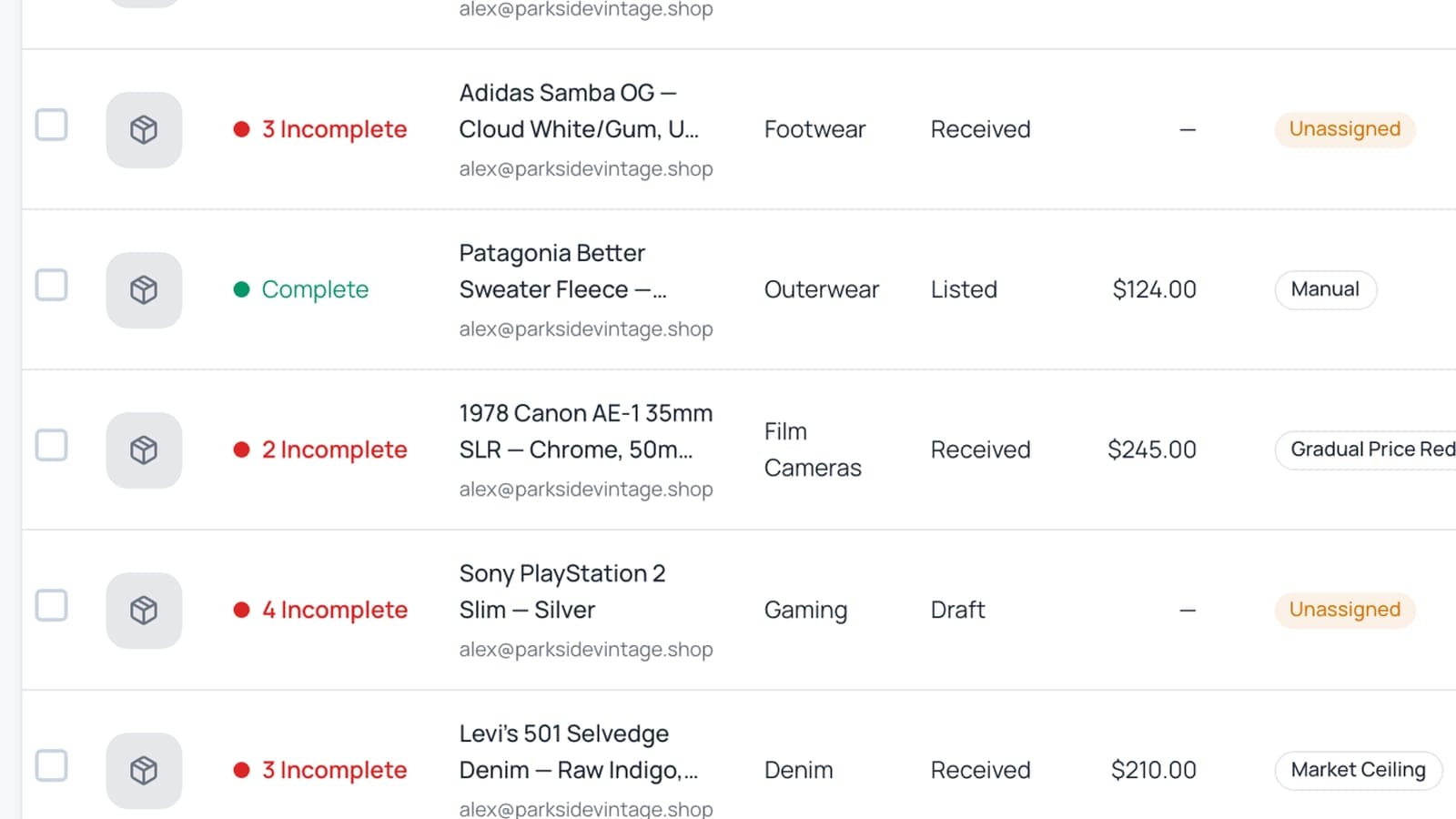
The efficiency trap is that speed makes it easy to accumulate hundreds of listings without any record of what you paid, where the record physically is, or which of your three copies of the same title is the one that just sold.
Do these three things at intake, before the record goes in a crate:
- Assign it an identifier and write it somewhere on or with the sleeve.
- Record what you paid.
- Record where it physically lives.
Sellers who skip this can still find records at fifty listings. At six hundred, “somewhere in the back room” becomes a real, order-delaying problem, and unpriced inventory makes it impossible to know whether the shop is actually profitable.
The Problem That Catches Almost Everyone
Most record sellers don’t stay on Discogs alone. eBay reaches a different, less specialist audience and often pays more for exactly the titles Discogs buyers undervalue — and the reverse is true too, which is why the comparison between the two marketplaces rarely resolves into “just pick one.”
The moment you list the same physical record in two places, you’ve created a race condition. Discogs orders arrive through an invoice flow, and there can be a real gap between the buyer committing and you seeing it. If that gap overlaps with an eBay sale, one buyer is getting a refund and an apology.
This is not a discipline problem. It happens to organized people, because the failure is in the timing, not the attention. A record sells at 2 a.m. in one channel and you’re asleep. The only structural fixes are:
- Don’t cross-list. Keep separate inventory per channel. This works, and it caps your reach and your sell-through rate.
- Delist immediately, always. Workable up to maybe five sales a day, and it fails on your busiest weekend — exactly when it costs the most.
- Keep one source of truth for quantity, and let every channel read from it. Sell anywhere, and availability drops everywhere within seconds rather than hours.
Only the third option scales. Whatever tooling you use to get there, the shape of the solution is the same: a single record per physical copy, and quantity that moves in one place.
A Weekly Rhythm Worth Keeping
Set aside twenty minutes a week to reconcile: walk your shelves against your listings, confirm quantities, and close out anything you’ve sold locally or pulled for your own collection. It’s tedious at a hundred listings and it’s the reason sellers at a thousand listings don’t have a slow-motion crisis. There’s a fuller version of this routine in our weekly reconciliation walkthrough.
The record sellers who last aren’t the ones with the best ears or the deepest crates. They’re the ones whose shop still tells them the truth about what they own when they have two thousand records and no memory of buying most of them.