
FOR COLLECTORS
Collection management software for people whose collection is also their stock
A collection record and a sellable-inventory record are not the same record. Instica keeps both in one catalogue, so the cost you wrote down when you acquired a piece is still attached to it years later, on the day you decide to let it go.
TWO RECORDS, ONE CATALOGUE
The distinction most catalogues make you choose between
Collector software generally assumes you are not selling, and reseller software generally assumes everything is for sale. A collector who sells a few pieces a year falls between the two and ends up running a spreadsheet beside an app, which is how acquisition costs get lost.
The useful model is one catalogue where a price and a channel are optional fields. What you own is the catalogue. What you are willing to sell is a state a piece can enter, and leave.
- The collection Not for sale
- Everything you own, whether or not you would part with it. Acquisition date, what you paid, where it came from, condition as you assessed it. This half of the catalogue exists so you can answer "what do I have" without opening a cupboard.
- The inventory Listed or listable
- The subset you are willing to sell, carrying a price, a channel and a listing state. A piece moves into this half when you decide to release it, which is a decision worth recording rather than one worth inferring from whether a listing happens to exist.
- Why they are one system Same item, two lives
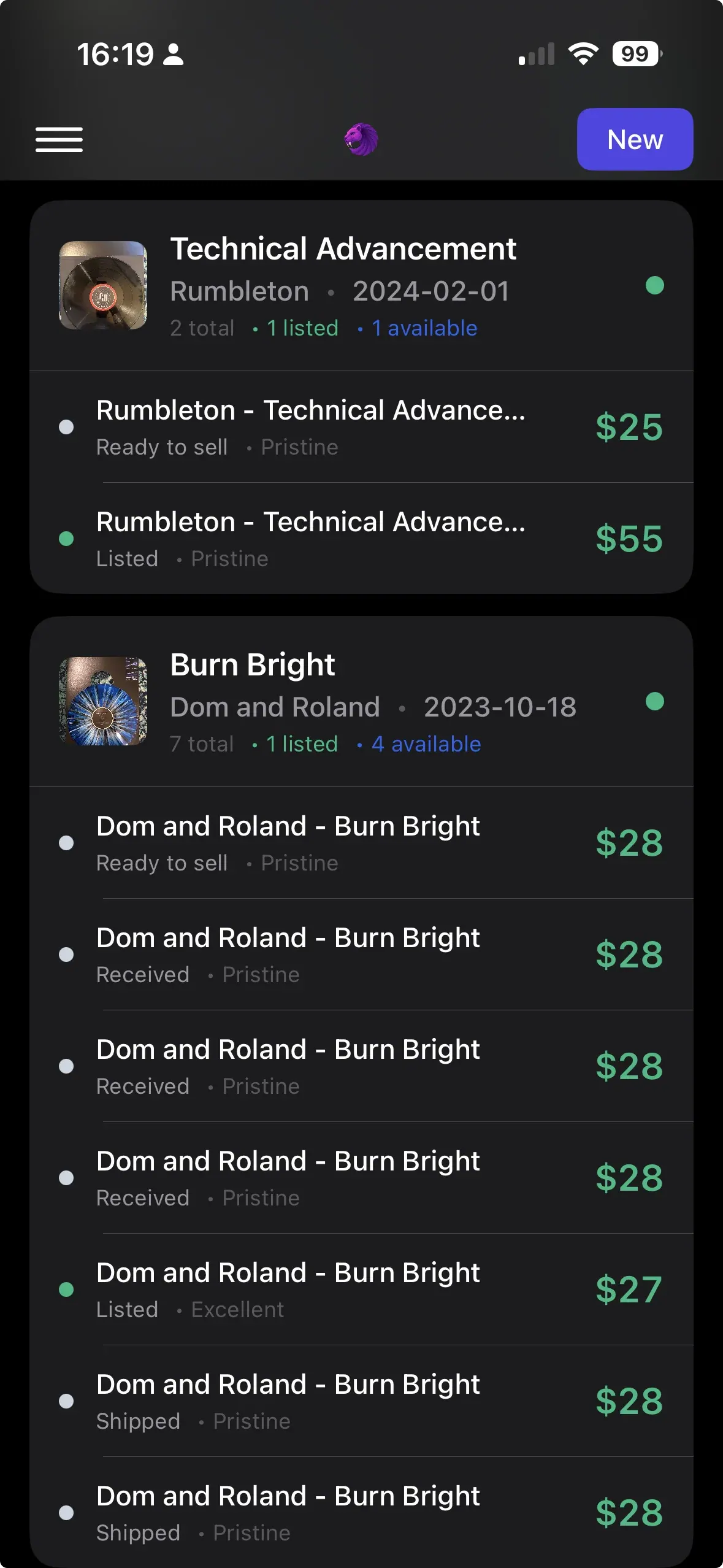
- Keeping them in separate tools means entering every piece twice and reconciling them by memory. Keeping them in one means the cost you recorded on acquisition is still attached years later when the piece sells, which is the only way the return is real rather than remembered.
WHEN A PIECE LEAVES
Partial liquidation is the normal case
Collections rarely sell all at once. They shed pieces — to fund the next acquisition, to cut a duplicate, because a run got finished. The records have to survive that without being rebuilt each time.
Selling three things, not the collection
Partial liquidation is the normal case and the awkward one. Releasing four pieces from a set of two hundred should not require pulling the set apart in your records, and the two hundred should still read as a collection afterwards.
The cost you recorded years ago
Cost basis is stamped when you acquire a piece, not reconstructed at sale. For a collector that gap is often years, which is exactly the interval over which nobody remembers what they paid. It is also what makes the profit figure at sale a fact rather than a guess.
Provenance survives the sale
Where a piece came from, what you paid, what condition you assessed and what it eventually sold for stay on one record. The sold half of a catalogue is the part that tells you whether your acquisition instincts were any good.
WHAT INSTICA DOES NOT DO
It does not tell you what anything is worth
Instica records your cost, your condition assessment and your sale price. It does not appraise, does not pull market comparables, and does not generate a valuation for an insurer or an estate. If that is the job you need done, a price guide or an appraiser does it and this does not.
What it holds is the half of the picture no price guide has: what you actually paid, when, from whom, and what you actually got for it. A guide can tell you the going rate for a piece. Only your own records can tell you whether you have been good at this.
BY WHAT YOU COLLECT
The field-specific problems live on their own pages
Grading queues, pressing variants, certification numbers and completeness are not one problem with six names. Each of these pages is about the mechanics of that field rather than a paragraph summarising it.
- Vinyl and music Pressings, matrix numbers and Discogs release matching.
- Sports cards Grading queues, submission cost and break allocation.
- Comics Issue, variant, printing and certification numbers.
- Antiques One-of-one stock where no two records repeat.
- Toys and collectibles Boxed versus loose, and completeness as a field.
- Video games Platform, region and manual-and-case completeness.
FREQUENTLY ASKED
Before you catalogue anything
The first two are the questions collectors ask before signing up, and the answer to the first one is no.
Does Instica tell me what my collection is worth?
No, and this is the honest limit of it. Instica records what you paid, what condition you assessed, and what a piece sold for if it sold. It does not appraise, does not pull market comparables, and does not produce a valuation you could hand to an insurer. What it gives you is your own cost and sale history in one place, which is the part no price guide can tell you.
Can I catalogue pieces I have no intention of selling?
Yes. A record does not need a price or a channel, and nothing pushes it to a marketplace until you list it. Items you are keeping and items you are selling live in the same catalogue precisely so that the day you change your mind about one of them is not a data-entry project.
Which marketplaces can I sell through?
eBay and Discogs. eBay is fully two-way, and Discogs is two-way on a scheduled sync rather than instantly. The channel-by-channel detail is on the marketplaces page rather than restated here.
Is the free plan enough to catalogue a collection?
The free plan covers 25 active listings. Cataloguing is not listing, so a large collection can sit in the catalogue on the free plan — but if you want more than 25 pieces listed for sale at once, Operator at $19 a month raises that to 500 and opens every connected channel.
From the reselling course
Reading for a collection that is also stock
Selling out of a collection you built makes every disposal decision financial and personal at once. The guides below take the financial half seriously: what a piece is worth, what can go wrong, and what is genuinely insured.
- 01Valuing Inventory Before You Buy It
Buying as a collector and buying as a seller are different disciplines. This separates them.
- 02Authentication and Counterfeit Risk
The provenance questions worth asking before money changes hands rather than after.
- 03Grading and Describing Condition
Describing a flaw plainly is what keeps a sale from becoming a dispute.
- 04Packing Fragile and High-Value Items
Shipping something irreplaceable, which is a different problem from shipping something expensive.
- 05Fraud, Scams, and Payment Risk
Collectible listings attract a particular kind of buyer attention. Recognise it early.
- 06Insurance and Business Risk
What a household policy covers once a collection is worth real money, and what it never did.
Free, no signup — the full course. If you would rather begin from your own bottleneck, take the three-minute diagnostic.
Start with 25 items. Stay for 25,000.
Free for 25 items · No card · Cancel from your account page.