
For Sports Card Sellers

Sports Card Inventory Software

Cards move on comps that can change in a week, and the cost side is buried inside breaks and lots — so the seller who knows their real per-card basis is the one who can price with any confidence.

✓ Graded and raw✓ Break cost allocation✓ Set and parallel detail

THE SHAPE OF THE PROBLEM

The hard part is the cost side, not the sell side.

Comps for a given card are public, argued over daily, and easy enough to look up. What almost nobody can produce on demand is the true cost of the specific card in their hand, because it arrived inside a four-hundred-dollar break alongside two hundred others, or in a bulk lot bought at a show, or as part of a trade with three legs.

Instica treats that allocation as a first-class input rather than an afterthought. When a card record carries a defensible cost, the pricing question becomes arithmetic. When it does not, every sale is a guess dressed up as a decision, and the guesses tend to run in the optimistic direction.

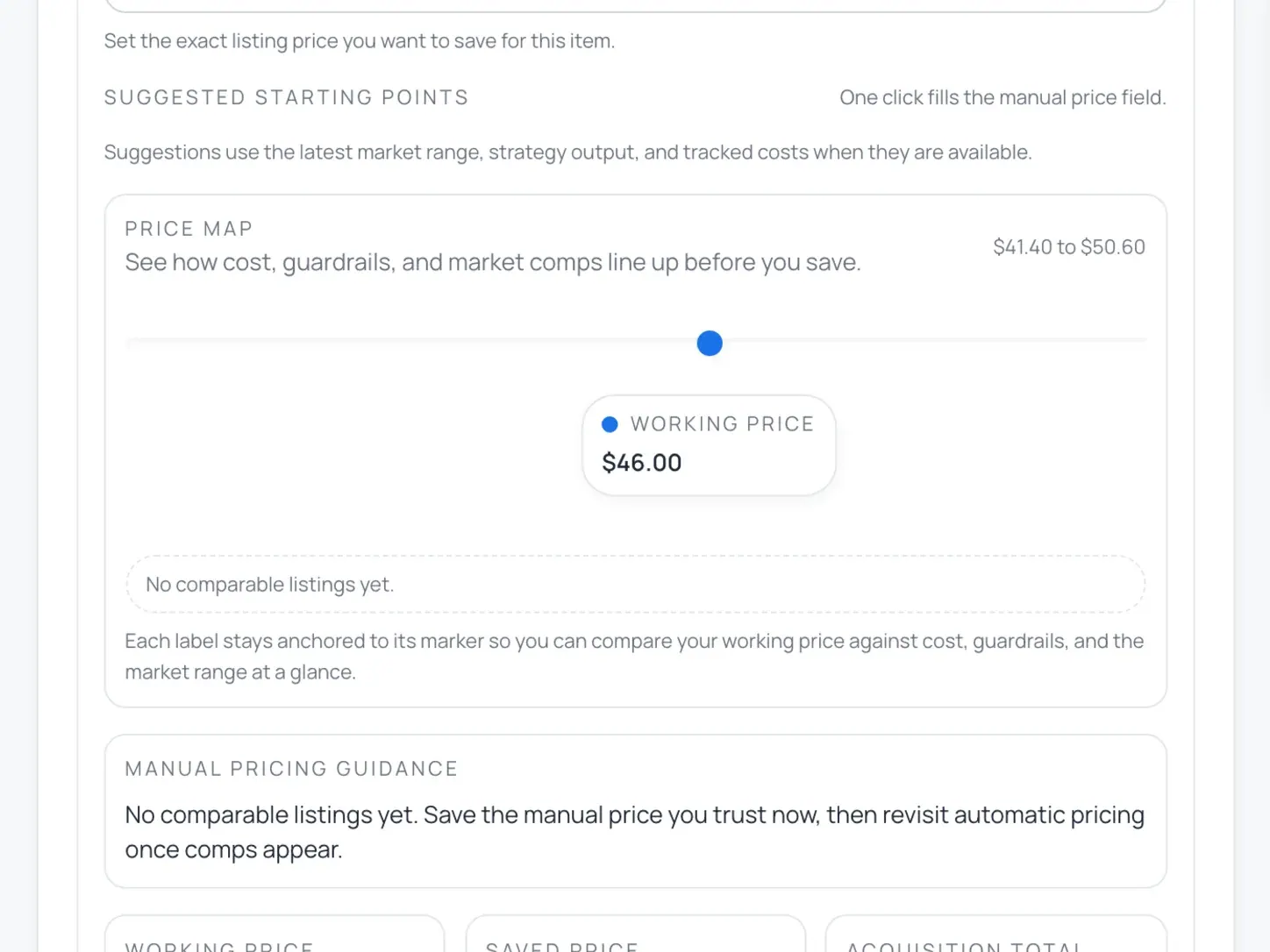
Instica pricing panel showing a guardrail price range, a working price and a note that no comparable listings were found
Pricing a card when the comp lookup comes back empty. The range and the working price stay yours to set; the panel says it found nothing rather than inventing a market.

WHAT THE RECORD HOLDS

Three things worth getting right

Catalogue by set, year and parallel

Year, set, subset, athlete and parallel are the axes buyers actually search on. Holding them as structured fields rather than as words in a title makes your own inventory searchable, which matters most when someone asks whether you have a specific card and you have four thousand of them.

Keep graded and raw distinct

A slabbed card with a certification number and a raw card with your own condition opinion are different assets that happen to share a name. Recording the grader, the grade and the certification separately keeps them from being conflated in your own numbers.

Allocate break costs at intake

Split what you paid for a break or lot across the cards that came out of it while the purchase is still fresh. This is the single number that determines whether your margin reporting means anything.

THE WORKFLOW

From break to listed card

Most card inventory arrives in bursts — a break, a show, a collection bought whole — and then gets processed over the following days. The workflow assumes that shape.

  1. 01

    Record the purchase as a unit first

    Log what the break, box or lot cost before you start pulling cards out of it. That total is the denominator for everything that follows, and it is much harder to recover once the cards are sorted into piles.

  2. 02

    Sort into keep, sell and bulk

    Most of what comes out of a break is bulk. Deciding that early stops you from spending catalogue time on cards whose realistic outcome is a hundred-count box sold by weight.

  3. 03

    Decide grading before listing

    Submission cost and turnaround are real money and real months. Recording the intended path on the card — raw sale, submission pending, slabbed — keeps you from listing something that is meant to be in a grading queue.

  4. 04

    Photograph for the flaw, not the front

    Centering, corner wear and surface lines are what a raw-card buyer is trying to assess. Photos that show those honestly at intake become both your listing images and your evidence if a return is disputed.

CHANNEL BY CHANNEL

Where cards sell, and what Instica does there

Instica connects to eBay, Shopify and Discogs. Card sellers should read that list with realistic expectations about which one carries their volume.

eBay
The centre of gravity for both graded and raw singles. Because eBay reports sales to Instica by webhook, a card that sells there is marked sold on the record and your other listings are updated from it.
Shopify
Useful for sellers who have built a following and want to run drops or a fixed shop without auction mechanics. Instica publishes products and pushes quantities to Shopify, but does not read Shopify orders back — a storefront sale is one you mark sold yourself.
Discogs
Built for music releases. It has no bearing on cards, and the honest answer to "can I list cards there" is no.

WHERE IT GOES WRONG

Where card sellers lose money

Break cost never allocated

If the cost of a break is only recorded as a lump sum, every card from it appears to be pure profit and the break itself appears to be pure loss. Sellers in that position routinely conclude that breaking is unprofitable when the real problem is that they cannot see which cards carried the return.

Grading costs left out of basis

Submission fees, shipping both ways and insurance can exceed the raw value of the card. A slabbed card whose basis still reads as the raw purchase price will look like a much better trade than it was.

Pricing against a peak comp

A single high sale from a hot week becomes the anchor, the card sits unsold for months, and the carrying cost is invisible because nothing tracks how long it has been listed. Stock age is the correction.

FREQUENTLY ASKED

Questions card sellers ask

How do I split the cost of a break across the cards I pulled?

Record the break as a purchase first, then assign a share of that cost to each card you decide to catalogue as you sort. Cards destined for bulk can carry a nominal share so the maths still balances without you cataloguing them individually.

Can I track cards that are out at a grader?

Yes. Keep the card as a record with its intended path noted, so it stays in your inventory count and out of your listable stock while it is in the queue. When it returns you update the record with the grade and certification rather than creating a new one.

Does Instica pull live comps or price cards for me?

No. Instica tracks what you paid, what you listed at, and what it sold for. Deciding what a card is worth today remains your call, and we would rather be clear about that than imply a valuation feature that does not exist.

From the reselling course

Reading for cards priced off comps

Cards trade on comparables that move inside a week, and they arrive in breaks and lots that hide their own cost. These six guides work the cost side first, then the risks that attach to a card worth shipping insured.

  1. 01
    Valuing Inventory Before You Buy It

    Allocating a break or lot cost across cards is where per-card profit is actually decided.

  2. 02
    Authentication and Counterfeit Risk

    Trimmed, altered and reprinted cards, and the checks that catch them.

  3. 03
    Grading and Describing Condition

    Centring, edges and surface described the way a grader and a buyer both read them.

  4. 04
    Packing Fragile and High-Value Items

    Sleeve, top-loader, team bag, rigid mailer — and why each step is there.

  5. 05
    Fraud, Scams, and Payment Risk

    The chargeback patterns that follow high-ticket card sales.

  6. 06
    Insurance and Business Risk

    Covering a case of cards at home and in transit, and the limits nobody reads.

All free — browse all 38 guides. Or run the three-minute seller diagnostic.

Start with 25 items. Stay for 25,000.

Free for 25 items · No card · Cancel from your account page.

También disponible en españolEspañol →
Disponível em portuguêsPortuguês →
Auf Deutsch verfügbarDeutsch →
Disponible en françaisFrançais →
中文版本可用中文 →