
CROSS-LISTING

Cross-listing software that tells you where it stops

Instica cross-lists across eBay, Shopify and Discogs from a single inventory record. That is three channels, not thirty — and knowing which three before you sign up is worth more to you than a longer list on a marketing page.

✓ One record per item ✓ Cost and net per sale ✓ 25 items free, no card

THE BOUNDARY FIRST

Start with the boundary, not the pitch

Cross-listing tools are usually sold on breadth: the number of channels on the logo wall is the headline, and the detail of what actually happens on each one is somewhere further down. That gets the order backwards. A tool covering twelve channels badly is worse than one covering three properly, and you cannot tell which you are buying from a logo wall.

Instica connects to eBay, Shopify and Discogs. Poshmark, Mercari, Depop, Vinted, Grailed, Etsy and Amazon are not connected channels, and there is no roadmap promise here standing in for one. If most of your volume lives on those platforms, a dedicated cross-lister is the right tool and we would rather you find that out on this page than after importing your catalogue.

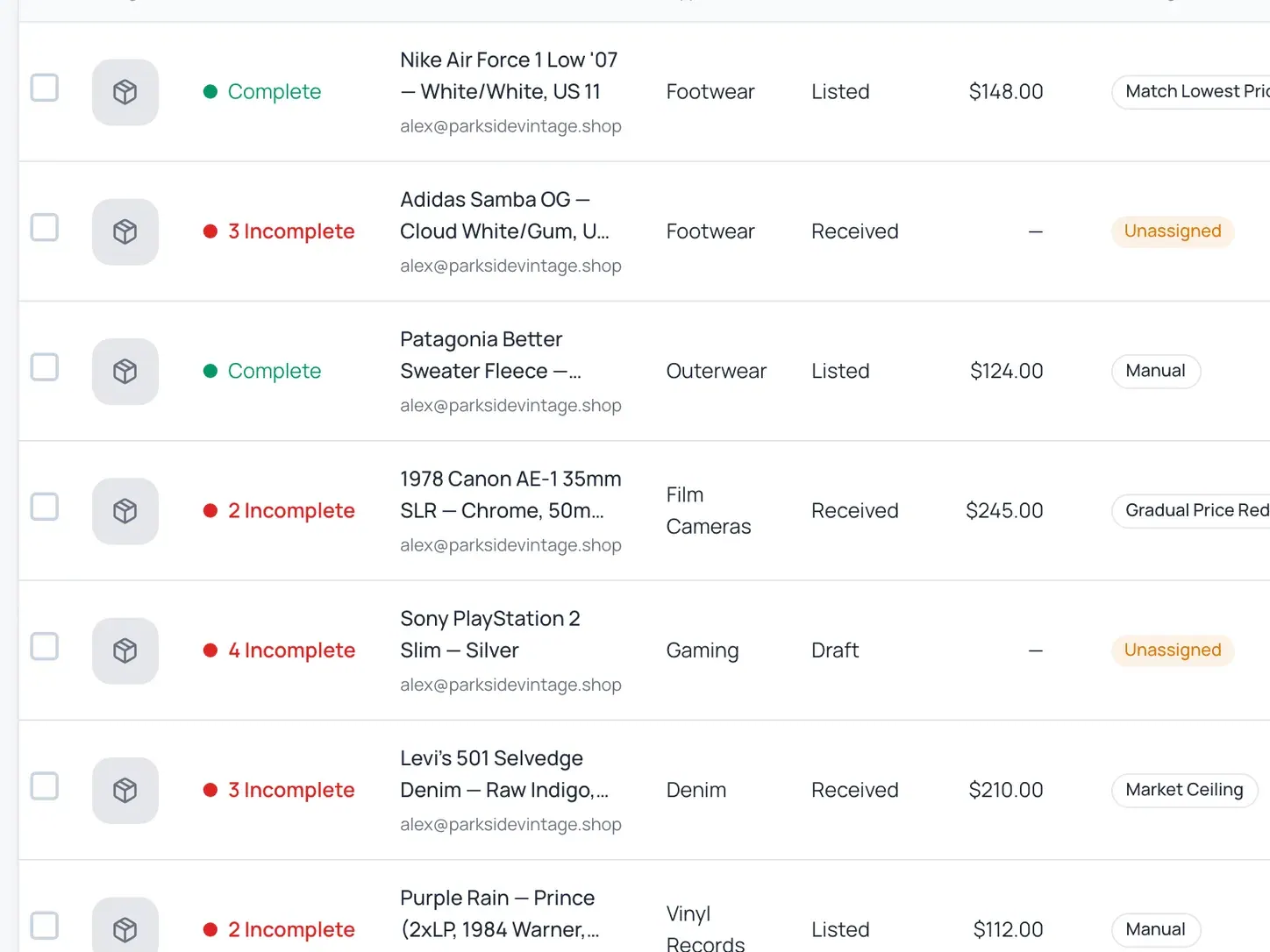
Instica inventory list showing one record per item with per-channel sync status
One record, three possible listings. The sync column is where the difference between push-only and two-way becomes visible.

CHANNEL BY CHANNEL

What each channel actually does

Pushing a listing out is the part every tool does. Hearing back about a sale is the part that varies, and it is the part that determines whether your inventory count can be trusted on a busy day.

eBay Full two-way
Listings publish from the item record, price and quantity changes push out, and sales come back by webhook. This is the channel where cross-listing behaves the way people expect it to.
Shopify Push only
Products are created and quantity updates are sent. Orders are not read back — the app requests product and inventory permissions, not order permissions — so a sale on your own storefront is one you record in Instica yourself.
Discogs Two-way, on a schedule
Listings and price updates go out, and orders come back on a polled sync rather than instantly. For vinyl and music stock it is the strongest catalogue match of the three.
Sync direction by channel Pushing out is universal. Reading back is not — and that difference is the one worth knowing before you rely on it.
Channel Instica to channel Updating the listing Channel to Instica Hearing about a sale
eBay Pushed automatically Price and quantity changes go out without you opening the channel. Detected right away The channel notifies Instica as soon as the order is placed.
Discogs Pushed automatically Price and quantity changes go out without you opening the channel. Detected on the next sync Instica reads your orders on a schedule, so there is a short delay.
Shopify Pushed automatically Price and quantity changes go out without you opening the channel. Not detected Instica does not request access to these orders, so you mark the item sold.

Detection is best effort, never a guarantee. A channel outage, a delayed sync, or two buyers checking out seconds apart can still leave you resolving an oversell with one of them.

WHERE IT GOES WRONG

Three ways cross-listing goes wrong

The listing is the record

Most cross-listing goes wrong because each channel holds its own copy of the truth. Correct a measurement in one place and the other two keep the old one, and by the third correction nobody knows which is right. Instica keeps one record and treats every listing as a view of it, which is a structural fix rather than a reminder to be careful.

Cost never travels with the item

Cross-listing tools optimise for getting an item onto more channels, which is the easy half. The half that decides whether the month worked is what the item cost, what the channel took, and what actually landed — and that only exists if cost was recorded at intake rather than estimated at tax time.

More channels than you can service

Every additional channel adds messages to answer, policies to track, and returns to process. Sellers who list everywhere frequently make less than they did on two channels done properly, because the operational load is invisible until it is unmanageable.

WHO THIS IS NOT FOR

When a dedicated cross-lister is the better choice

If your business is apparel moving across Poshmark, Mercari and Depop, the tools built for that set will do more for you than Instica will, and the honest recommendation is to use them. Instica is built around a different centre of gravity: an inventory record that carries cost, condition and history, connected to a smaller set of channels where the integration is deep rather than nominal.

The sellers it suits are the ones for whom the ledger matters as much as the listing — people running eBay alongside their own Shopify storefront, record dealers working Discogs and eBay together, or anyone who has realised their spreadsheet stopped being accurate several months ago and wants the cost side to be real again.

FREQUENTLY ASKED

Common questions

Which channels does Instica cross-list to?

Three: eBay, Shopify and Discogs. Poshmark, Mercari, Depop, Vinted, Grailed, Etsy and Amazon are not connected channels. If your selling is concentrated on those, a dedicated cross-listing tool will serve you better than Instica will.

What happens when an item sells on one channel?

It depends on the channel, and the difference matters. eBay notifies Instica by webhook, so the record is marked sold and your other listings are updated from it. Discogs orders arrive on a scheduled sync rather than instantly. Shopify orders are not read back at all, because the app does not request that permission — a storefront sale is one you mark sold yourself.

Does cross-listing with Instica prevent double sales?

It shortens the window in which a sold item is still listed elsewhere. It does not close it. Two buyers checking out within the same few seconds, or an API outage on one channel, can still leave you cancelling on someone. Any tool claiming otherwise is describing a guarantee no marketplace API can give it.

Do I need a paid plan to cross-list?

The free plan covers 25 listings on a single channel, which is enough to see how the record-first workflow behaves but not enough to cross-list. Operator at $19 a month opens all connected channels with a 500-listing ceiling.

Start with 25 items. Stay for 25,000.

Free for 25 items · No card · Cancel from your account page.

También disponible en españolEspañol →
Disponível em portuguêsPortuguês →
Auf Deutsch verfügbarDeutsch →
Disponible en françaisFrançais →
中文版本可用中文 →