
For Antique Dealers

Antique Dealer Inventory Software

Antiques break every assumption that inventory software usually makes: no catalogue match, no comparable in stock, and a shipping problem that starts before you have bought the piece.

✓ No-catalogue items✓ Provenance notes✓ Dimensions and fragility

THE SHAPE OF THE PROBLEM

Nothing you sell has a barcode, and nothing you sell has a duplicate.

Most reseller tooling assumes a product database: scan the code, pull the title, done. That assumption fails completely on a Victorian side table, a piece of studio pottery with an unclear mark, or a run of estate silver. Each item is singular, its identification is partly a research task, and what you write about it is a substantial part of what you are selling.

Instica is built to hold that. Records are created from your own description, photographs and measurements rather than from a lookup, and the research you do — the maker mark you identified, the estate the piece came from, the repair you found on the underside — stays attached to the item permanently rather than living in the listing you will eventually take down.

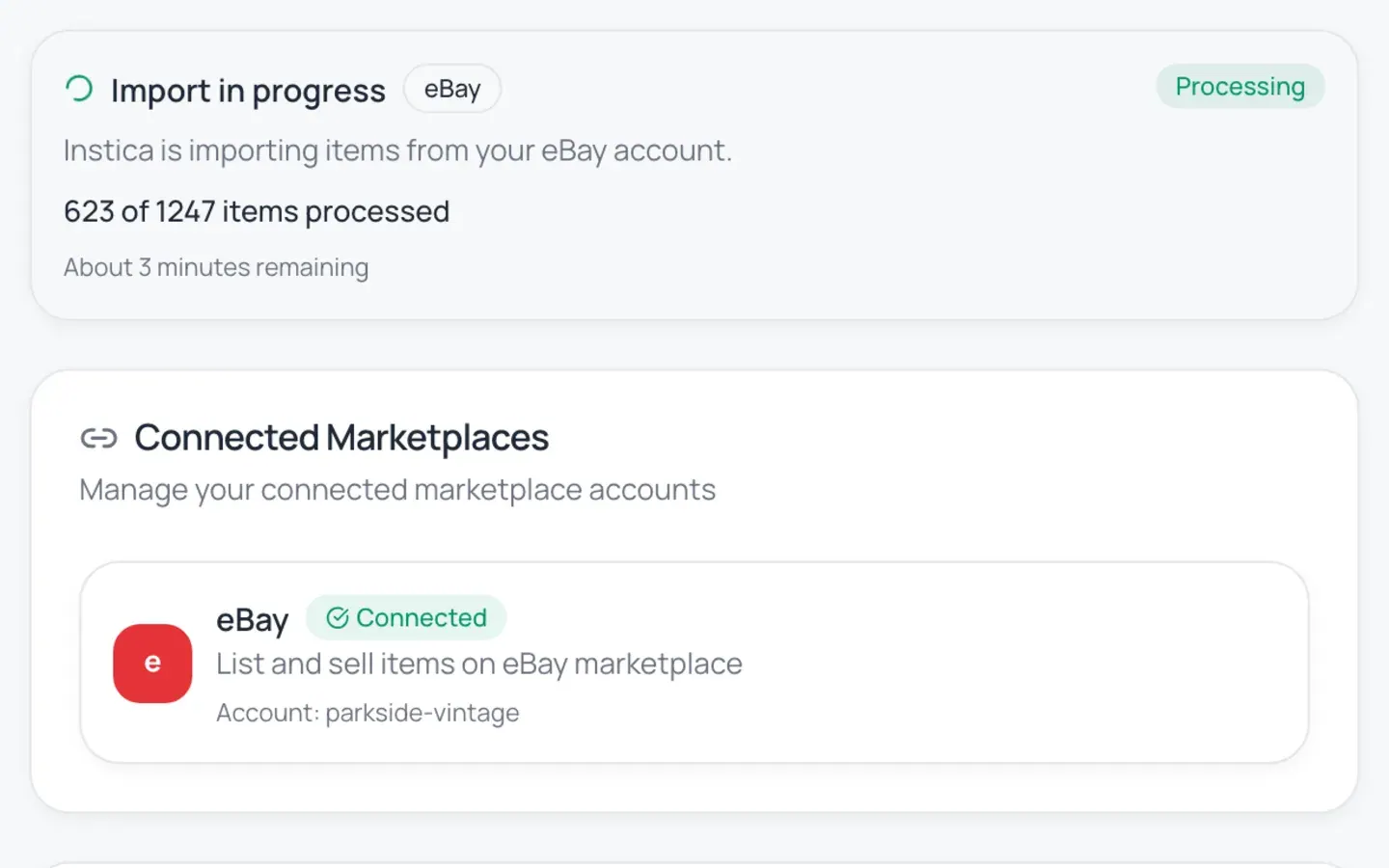
Instica import wizard showing items being queued and matched during setup
Nothing here matches a catalogue. The record is built from what you measured and researched, not from a scanned identifier.

WHAT THE RECORD HOLDS

Three things worth getting right

Records without a catalogue match

Items are created from your photographs and your description. There is no requirement for a barcode, an ISBN or a database entry, which is the baseline requirement for anything that is going to be usable in this trade.

Provenance and research on the item

Where a piece came from, what the mark appears to be, what you could and could not verify. This is the material a serious buyer asks about, and it belongs on the record so it survives across every listing and every year you hold the piece.

Dimensions, weight and fragility

For furniture, glass and ceramics the shipping question determines whether a sale is even possible. Capturing measurements at intake is what lets you answer a buyer immediately rather than going back to the warehouse with a tape measure.

THE WORKFLOW

From the estate sale to a listed piece

Antique sourcing involves buying under time pressure, in a crowded room, on items you may not be able to identify until later. The workflow assumes research happens after the purchase, not before.

  1. 01

    Photograph marks and damage on site

    Undersides, backstamps, joins, repairs and hallmarks. These photographs are what you will do your identification from, and going back to an estate sale for a better picture is not an option.

  2. 02

    Measure and note weight before it is wrapped

    Once a piece is packed for the van it may not be unwrapped again until it sells. Dimensions taken at the point of purchase decide what you can quote for shipping and whether the piece is a local-collection item.

  3. 03

    Record the cost against the lot

    Auction lots and estate buys mix pieces of very different value. Attributing the cost sensibly across them is what makes the eventual margin figures meaningful, and it is far easier on the day than months later.

  4. 04

    Do the research, then write it down once

    Identification work is the expensive part of this trade. Writing it onto the record rather than straight into a listing means it is still there next season when the piece is relisted or a buyer asks a question.

CHANNEL BY CHANNEL

Selling channels, honestly assessed

Instica connects to eBay, Shopify and Discogs. Antique dealers usually sell through several routes that no software touches, so it is worth being clear about the boundary.

eBay
Best reach for smalls, ceramics, silver and anything postable. eBay reports sales to Instica by webhook, so a sold piece is marked and your other listings are updated from the record.
Shopify
The right home for a dealer with a named specialism and returning clients. Instica publishes products and pushes quantity to Shopify but does not read Shopify orders back, so those sales are marked sold by you.
Discogs
Relevant only if you also handle records, in which case it is genuinely useful for that part of the stock and irrelevant to the rest.

WHERE IT GOES WRONG

Where antique dealers lose money

Buying without a shipping plan

A large fragile piece bought cheaply can be effectively unsellable outside a collection radius. Recording dimensions and weight at purchase turns that from a discovery made after listing into a decision made before buying.

Research living only in the listing

Identification work written into a listing description disappears when the listing ends, and the next time the piece is offered it gets researched again from scratch. That is the same expensive hour spent twice.

Undisclosed restoration

Repairs, replaced parts and later additions materially change value, and a knowledgeable buyer will find them. Recording what you found at intake means the disclosure is in the listing automatically rather than depending on memory.

FREQUENTLY ASKED

Questions antique dealers ask

Can I catalogue items that have no barcode or database entry?

Yes, and that is the normal case here. Records are built from your own photographs, measurements and description, with no lookup required at any point.

Where do provenance and condition notes live?

On the item record, separate from the listing text. That way they persist through relisting, price changes and moves between channels, and they are still there years after the original listing came down.

Does Instica help with valuation?

No. It records what you paid, what you asked and what you realised. Valuing antiques depends on expertise and comparables that we do not hold, and we would rather be plain about that than suggest a capability we lack.

From the reselling course

Reading for stock with no barcode and no duplicate

Nothing you sell has a catalogue match or a comparable sitting in stock, and the freight question starts before you have bought. These six guides are written for one-of-one inventory.

  1. 01
    Valuing Inventory Before You Buy It

    Pricing a piece with no comparable, at an estate sale, under time pressure.

  2. 02
    Authentication and Counterfeit Risk

    Attribution, repair and reproduction — the three claims that need evidence behind them.

  3. 03
    Grading and Describing Condition

    Age, wear and earlier restoration described so a buyer knows what is arriving.

  4. 04
    Packing Fragile and High-Value Items

    Crating, freight, and the pieces that should not be shipped at all.

  5. 05
    Fraud, Scams, and Payment Risk

    A high-value one-off attracts approaches that ordinary stock does not.

  6. 06
    Insurance and Business Risk

    Cover for stock in a van, a unit and a booth, which are three different risks.

All free to read — the full guide index. If you would sooner start from your own bottleneck, use the three-minute diagnostic.

Start with 25 items. Stay for 25,000.

Free for 25 items · No card · Cancel from your account page.

También disponible en españolEspañol →
Disponível em portuguêsPortuguês →
Auf Deutsch verfügbarDeutsch →
Disponible en françaisFrançais →
中文版本可用中文 →