
For Book Resellers

Bookseller Inventory Software

Books are a volume business with thin per-unit margins, which makes the cost of carrying a title that will not sell the number that actually decides your year.

✓ ISBN and barcode capture✓ Edition-level detail✓ Dead-stock visibility

THE SHAPE OF THE PROBLEM

The problem with books is not listing them. It is knowing which ones to stop carrying.

A book seller can scan a hundred spines in an afternoon and have every one of them listed by evening. That part is solved. What is not solved is the shelf of titles bought eighteen months ago at a library sale that have each been viewed twice, priced down three times, and are still sitting there consuming the only genuinely scarce resource in this business, which is space you can reach.

Instica is built around the record rather than the listing. Each title carries what you paid, when you bought it, what condition you graded it at, and how long it has been in stock. That turns "should I keep pricing this down" from a feeling into a lookup, and it is the reason the ledger matters more than the listing tool for anyone working at book volumes.

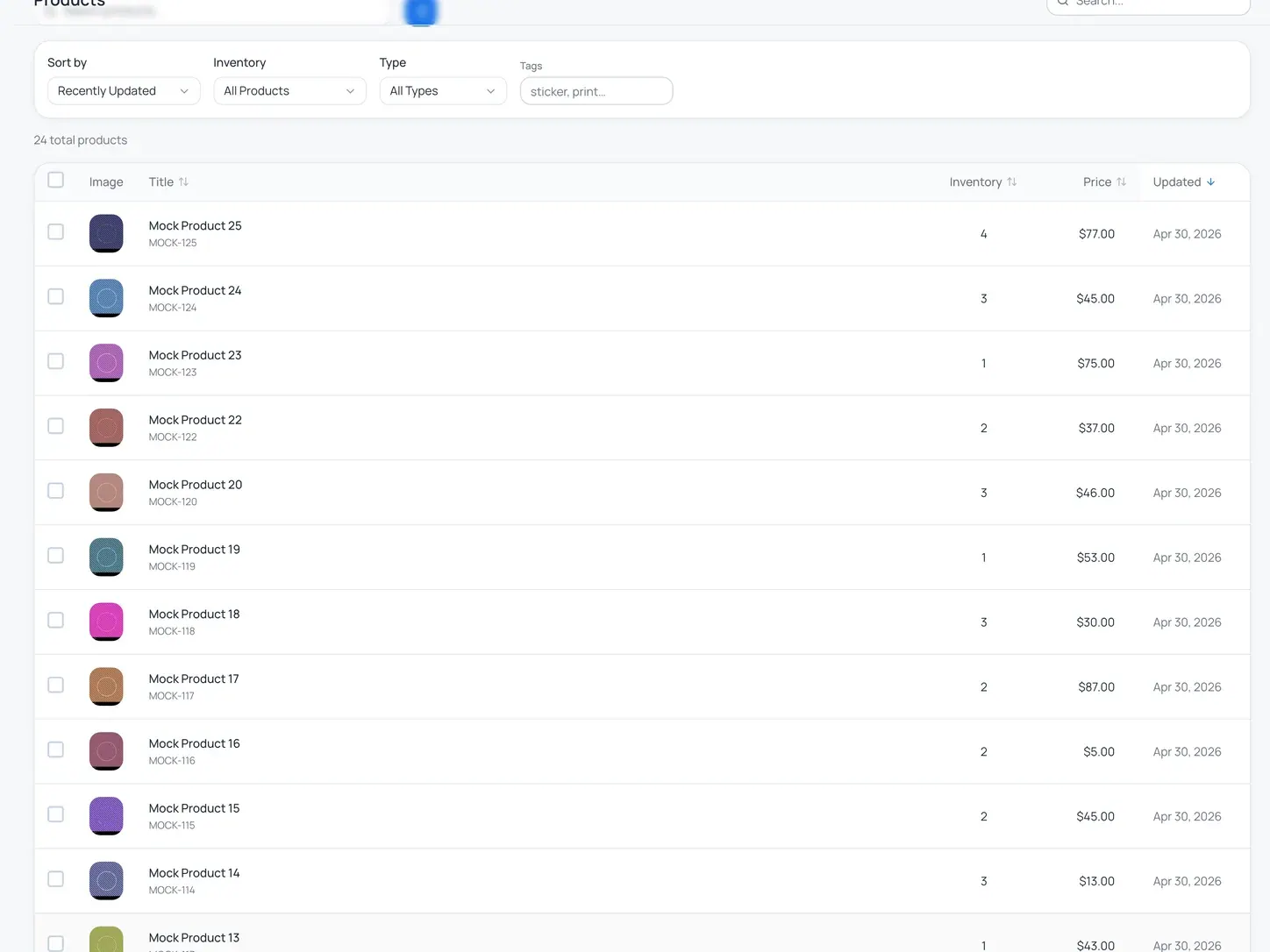
Instica catalog import screen matching incoming titles against existing inventory records
Importing a lot: each title becomes its own record, so the cost split across the lot is recorded once rather than reconstructed later.

WHAT THE RECORD HOLDS

Three things worth getting right

Capture at the ISBN

Scan the barcode and create a draft while you are still at the sale table. Edition, printing and jacket state are the fields that decide price on anything older than a mass-market paperback, and they are much easier to record with the book in your hand than from a photo later.

Grade once, consistently

Condition notes live on the item, not in the listing text, so the same description follows the title everywhere you offer it. Buyers return books over condition disputes more than any other reason, and an inconsistent grade between two channels is how those disputes start.

Watch age, not just price

Every item records its intake date. Sorting by days in stock surfaces the titles that have quietly failed, which is a different and more useful list than sorting by lowest price or fewest views.

THE WORKFLOW

A sourcing run, end to end

Book sourcing is high count and low value per unit, so anything that costs you thirty seconds per title costs you an hour per run. The workflow below is built around doing the slow parts once.

  1. 01

    Scan and triage on site

    Create draft records by barcode as you pull titles. Anything without a scannable ISBN — pre-1970 stock, ex-library rebinds, imports — gets a photo and a manual entry, because those are exactly the ones where edition detail carries the value.

  2. 02

    Set cost basis before you leave

    Lot purchases are the usual case: forty books for twenty dollars. Splitting that across the records at intake is the only moment you will reliably remember the split. Reconstructing it in March from a receipt that says "BOOKS $20" is guesswork.

  3. 03

    Grade against the shelf, not the screen

    Record condition while the physical copy is in front of you. Foxing, remainder marks, price-clipped jackets and tight-versus-cracked spines are the details that separate a nine-dollar copy from a forty-dollar one.

  4. 04

    List from the record

    Once the record is complete the listing is mechanical. Push it to the channels you sell on and let the record stay authoritative, so a later condition correction updates one place rather than three.

CHANNEL BY CHANNEL

Which channels are actually worth your time

Instica connects to eBay, Shopify and Discogs. For a book seller that is a short and honest list, and it is worth being clear about which of the three will do anything for you.

eBay
Where most non-fiction, textbooks and collectible editions move. An eBay sale reaches Instica by webhook, so the item is marked sold and your other listings are updated without you doing anything.
Shopify
Worth it once you have a named specialism — a genre, a press, a region — that people seek out directly. Instica pushes products and quantities out to Shopify but does not read your Shopify orders back, so a sale on your own storefront is one you mark sold in Instica yourself.
Discogs
A music catalogue. Unless you also deal in records it will not help you, and we would rather say that than imply coverage that does not exist.

WHERE IT GOES WRONG

Where book sellers lose money

Cost basis reconstructed from memory

Books are bought in lots and sold individually, which means per-unit cost is always a calculation rather than a receipt line. Sellers who do that calculation at tax time systematically overstate profit, because the titles that never sold are the ones they forget to count.

Shipping estimated instead of measured

A hardcover in a flat-rate mailer and a hardcover that needs a box are different businesses at book margins. Recording weight at intake takes a few seconds and prevents the class of sale that nets under a dollar.

Holding for the price you paid

The purchase price is gone regardless of what happens next. The only live question is what the title will realise now against the shelf space it occupies, and a stock-age view answers that better than a pricing history does.

FREQUENTLY ASKED

Questions book resellers ask

Can I catalogue books without a scannable ISBN?

Yes. Older stock, ex-library copies and imports are created as manual records with photos and your own edition notes. These are usually the titles worth the most care, since edition and printing detail is where the value sits.

How should I handle a lot purchase across many titles?

Split the lot cost across the records at intake, while you still know what you paid and what came in the box. Instica keeps that per-item cost on the record, so margin later reflects the actual acquisition rather than an estimate made at year-end.

How many titles can I keep on the free plan?

The free plan covers 25 listings on one channel, which is enough to work through a first sourcing run and decide whether the record-first approach suits you. Operator raises that to 500 listings across all channels at $19 a month.

From the reselling course

Reading for titles you should stop carrying

Books are a volume trade on thin per-unit margins, so the number that decides the year is what it costs to keep a title that will not sell. Six guides, from where to list to what to let go.

  1. 01
    Choosing Where to Sell

    Where a given title actually sells, as against where it merely sits.

  2. 02
    Item Specifics and Structured Data

    Edition, printing and ISBN fields, which is how book buyers filter.

  3. 03
    Writing Listing Titles and Keywords Buyers Search

    Writing a title that matches the search rather than the spine.

  4. 04
    Buying Collections and Job Lots

    Job lots and library sales, priced on the sellable fraction rather than the count.

  5. 05
    Cross-Listing Without Overselling

    The same ISBN in several places, without selling a copy you no longer have.

  6. 06
    Shipping Costs and Postage Strategy

    Media rates and weight bands, and the postage that quietly consumes a thin margin.

All free — the whole 38-guide course. If the constraint is unclear, work through the three-minute diagnostic.

Start with 25 items. Stay for 25,000.

Free for 25 items · No card · Cancel from your account page.

También disponible en españolEspañol →
Disponível em portuguêsPortuguês →
Auf Deutsch verfügbarDeutsch →
Disponible en françaisFrançais →
中文版本可用中文 →