

Most resellers discover bookkeeping in February, in a panic, with a year of marketplace deposits and no idea what any of the underlying items cost.
That reconstruction is genuinely awful, and it’s also unnecessary. The information that makes tax season easy is information you already have at the moment you buy something — you just have to write it down then instead of trying to remember it eleven months later.
This guide is about what to record, why marketplace payouts make everything harder than it should be, and how to build records you can actually file from. It’s operational guidance, not tax advice; the specifics of your situation belong with an accountant who knows them.
The One Habit That Fixes Most of It
Record what you paid, per item, at the moment you pay it.
That’s the whole thing. Everything hard about reseller bookkeeping traces back to a missing cost basis, because without it you cannot compute profit on a sale, value your unsold inventory, or substantiate anything if you’re ever asked to.
Reconstructing cost basis later ranges from tedious (matching bank statements to acquisitions) to impossible (a $60 cash box lot at an estate sale eighteen months ago that became forty separate items). And an estimate you invented in April is not a record.
For box lots and bulk buys, allocate the total across the items. Any defensible method works — per unit, weighted by expected resale value, by weight for bulk media. What matters is that you use the same method consistently and can explain it. A rough consistent allocation beats a precise one you never made.
Capture the costs that come after purchase too: cleaning supplies, replacement sleeves, grading fees, parts, the shipping you paid to acquire it. Sellers who track only the purchase price systematically overstate their margins, sometimes by a lot.
Why Marketplace Payouts Obscure Everything
Marketplace deposits are not revenue. This is the second-biggest source of confusion after cost basis.
A single deposit typically bundles several orders, already net of fees, sometimes net of refunds, sometimes spanning a period boundary, and often with shipping label costs deducted somewhere along the way. If you book the deposit as income, three things are wrong at once: your gross revenue is understated, your fee expenses are invisible, and your period boundaries are off.
That matters because fees are frequently your largest expense category, and expenses you never recorded are deductions you didn’t take.
The correct model has three separate layers:
- Gross sale price — what the buyer paid, per order.
- Fees and costs — marketplace commission, per-order fees, payment processing, shipping labels, refunds.
- Net deposit — what actually arrived in your bank account.
Your books need all three, and they need to reconcile: gross minus costs should equal the deposit. When it doesn’t, something is missing, and finding it in February is much harder than noticing it in July. We’ve written in more detail about why eBay payouts complicate bookkeeping specifically, because the aggregation behavior trips up nearly everyone.
Cash vs. Accrual, and Why Inventory Makes It Interesting
The point that surprises new sellers: buying inventory is generally not an immediate expense.
Money spent on goods you haven’t sold yet is typically treated as inventory — an asset — rather than a deduction in the year you bought it. The cost becomes deductible as cost of goods sold in the period the item actually sells. A seller who spends heavily on stock in Q4 and books it all as an expense that year can end up with a return that doesn’t reflect reality.
This is exactly why per-item cost basis is load-bearing rather than merely nice to have. To compute cost of goods sold you need to know the cost of the specific goods that sold. Aggregate spending won’t tell you.
There are simplified methods available to smaller businesses in some jurisdictions, and the rules differ by country and by how your business is structured. This is precisely the kind of thing worth one conversation with an accountant early on — it’s inexpensive, it’s a one-time decision, and getting it wrong compounds annually.
What Marketplaces Report About You
Marketplaces and payment processors report seller income to tax authorities. The thresholds that trigger those forms have changed repeatedly in recent years and vary by country and sometimes by state, so any specific number you read in a blog post — including this one — should be verified against current official guidance before you rely on it.
Two things are stable regardless of the threshold:
Income is reportable whether or not you receive a form. The form is a reporting mechanism, not the thing that creates the obligation.
The reported figure is usually gross, before fees. So the number the marketplace reports will be substantially larger than what you actually received. If your records don’t document the fees, shipping, and cost of goods that bridge the gap, you’re in the awkward position of being reported on a number you can’t reduce.
That asymmetry is the practical argument for good records: the gross number is documented for you automatically, and every offsetting figure is your responsibility.
Sales Tax Is a Separate Problem
Sales tax is not income tax and doesn’t behave like it. In most US states, marketplace facilitator laws mean the marketplace collects and remits sales tax on your behalf for orders placed through it — which is a genuine simplification, and also a trap, because it doesn’t extend to sales you make through your own storefront, at shows, or locally.
If you sell anywhere other than a marketplace, that’s a separate registration and filing question in the jurisdictions where you have obligations. The sales tax details sellers most often get wrong is worth reading if you’re at that stage.
A Bookkeeping Setup That Works
Separate the money. A dedicated bank account and card for the business, from day one. This single step eliminates most of the difficulty, because reconstructing which of two hundred personal transactions were business expenses is the other February nightmare.
Track per item, not per month. Item-level records roll up into monthly summaries automatically. Monthly summaries never decompose back into item-level truth. Always record at the finer grain.
Keep the receipts. Photograph them at the point of purchase. Thermal paper from a garage sale is illegible within a year, and a photo takes four seconds.
Reconcile monthly, not annually. Match deposits to orders once a month while you still remember the anomalies. An hour twelve times beats a weekend once, and it catches the errors — a duplicate refund, a missing payout — while they’re still fixable.
Know your real margin per item. Gross sale price minus fees, shipping, and cost of goods. This is the number that tells you whether a category is worth continuing, and it’s often unpleasantly smaller than sellers expect. Our profit margin calculator runs the arithmetic if you want to sanity-check a few items by hand before you commit to a category.
What Good Records Look Like
At year end you should be able to produce, without reconstruction:
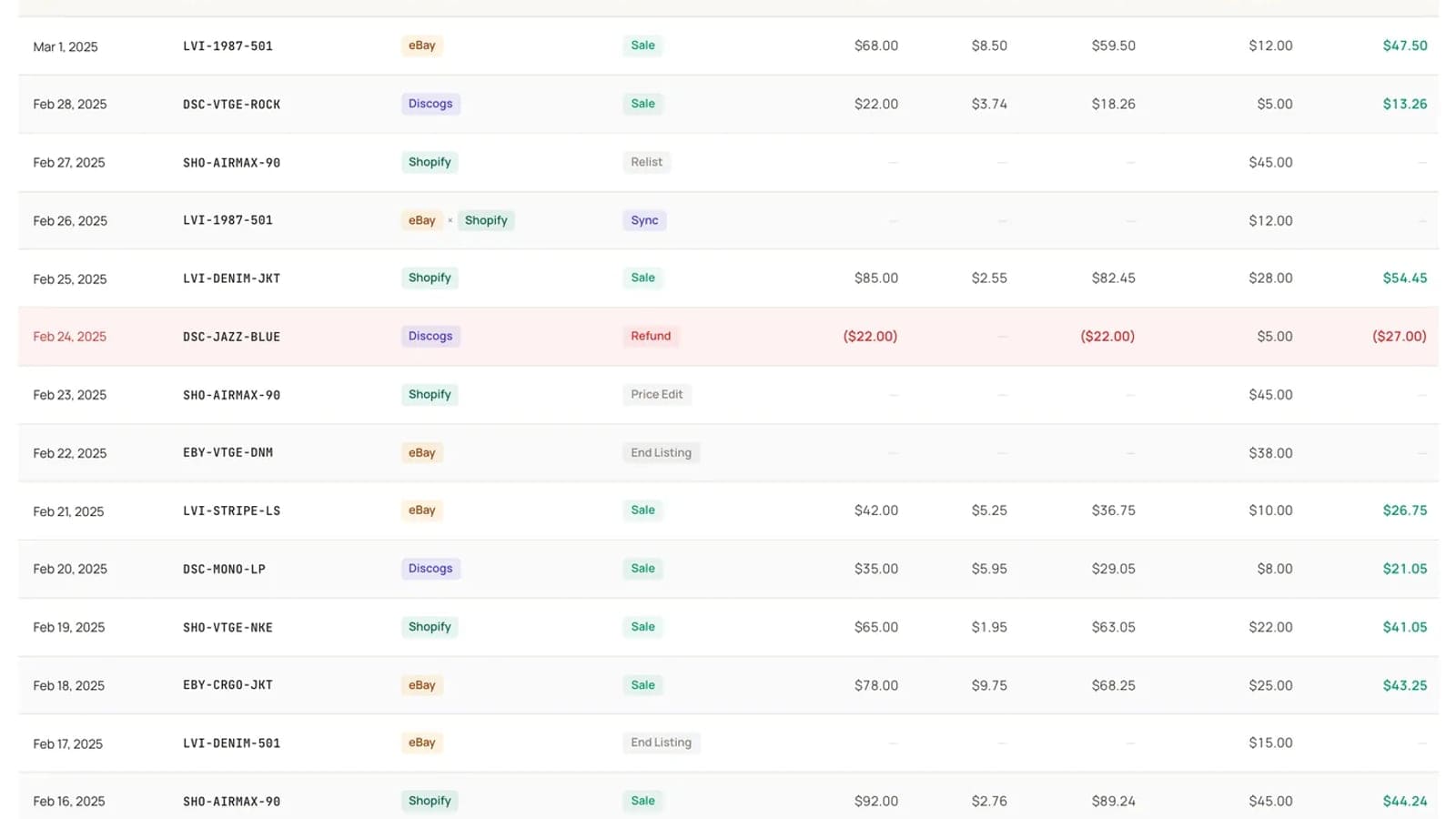
- Every sale, with date, gross price, fees, shipping cost, and the cost basis of the item sold.
- Every purchase, with date, amount, and what it bought.
- The cost of everything still in inventory on the last day of the year.
- Business expenses that aren’t inventory: supplies, mileage, software, fees.
If you can export those four things, filing is a data-entry exercise rather than an investigation. If you can’t, you’re going to spend a weekend guessing, and the guesses will be conservative in the direction that costs you money — because it’s far easier to underclaim deductions you can’t document than to defend ones you can’t substantiate.
The deeper point is that these records aren’t only for the tax authority. Knowing your true profit per item is what tells you which categories to double down on and which to abandon. Most sellers who start tracking properly discover that some part of their business they felt good about was quietly losing money — and that’s worth far more than the filing convenience.