

There’s a point in most resale businesses where the marketplaces start to feel like a landlord. You’ve built the audience, you’ve done the photography, you’ve earned the feedback — and every sale still routes through someone else’s checkout, at someone else’s fee schedule, with someone else’s rules about how you may contact the person who just bought from you.
That’s usually when Shopify enters the conversation. This guide is about doing it without wrecking the operation you already have.
What a Storefront Is Actually Good At
Be clear-eyed about what changes and what doesn’t.
A storefront does not bring you traffic. This is the single most expensive misunderstanding in the category. eBay and Discogs are demand engines — people arrive already searching for the thing you’re selling. Shopify is a building with no street. If nobody knows the URL, nobody comes.
A storefront does give you things marketplaces structurally cannot: direct customer relationships and an email list you own, no per-order marketplace commission, complete control over presentation, and the ability to sell things marketplaces restrict or handle badly — bundles, pre-orders, subscriptions, consignment arrangements.
The sellers for whom this works have an existing audience to point at it. That might be repeat marketplace buyers, an Instagram following, a local customer base, or a niche community that already knows your name. If you have none of those, a storefront is a project, not a channel — and your time is almost certainly better spent adding listings to the marketplaces that already send you buyers.
The honest sequence for most sellers is: marketplaces first, storefront second, and the storefront’s job is to capture demand you already generate rather than to create new demand.
The Structural Problem: Two Inventories, One Shelf
Here is what actually breaks.
Marketplaces and Shopify each maintain their own idea of how many of a thing you have. Shopify thinks it has one. eBay thinks it has one. You have one. That arithmetic works right up until both are correct simultaneously and two people buy.
Overselling in this configuration is worse than overselling across two marketplaces, for a specific reason: Shopify customers are the customers you were trying to build a direct relationship with. The whole point of the storefront was to own that relationship. Cancelling their order in week two of your storefront’s life is an expensive way to introduce yourself.
The failure mode is always timing, not attention. Marketplace order notifications aren’t instant. Shopify’s checkout is. A record or a card or a jacket that sells on Discogs at midnight is still purchasable on your storefront until you wake up and pull it.
How Quantity Should Actually Flow
There’s one correct architecture and several tempting wrong ones.
Wrong: Shopify as the master, marketplaces updated manually. This is the most common first attempt because Shopify’s admin is pleasant to use. It fails because marketplace sales don’t flow back — you’re hand-decrementing Shopify every time eBay sells something, which is exactly the manual reconciliation you were trying to escape.
Wrong: separate inventory pools per channel. Reserve five for Shopify, five for eBay. This genuinely prevents oversells and it wastes your inventory. Half your stock is invisible to the channel where it would have sold.
Right: one record per physical item, one authoritative quantity, every channel reading from it. A sale anywhere decrements the single count, and every other channel’s listing updates to match within seconds. Not overnight. Seconds matter here because the whole exposure window is measured in hours.
This is the same principle that governs any cross-listing setup, and it doesn’t change just because one of the channels is your own website. Your storefront is a channel like any other. It should not be a second database.
Getting Your Catalog In Without Duplicating It
The migration step is where sellers accidentally create the two-database problem they were trying to avoid.
If you already have hundreds of marketplace listings, do not rebuild them by hand in Shopify. Beyond the obvious hours, hand-rebuilding guarantees drift: the Shopify description says one thing, the eBay description says another, and six months later you can’t remember which is right.
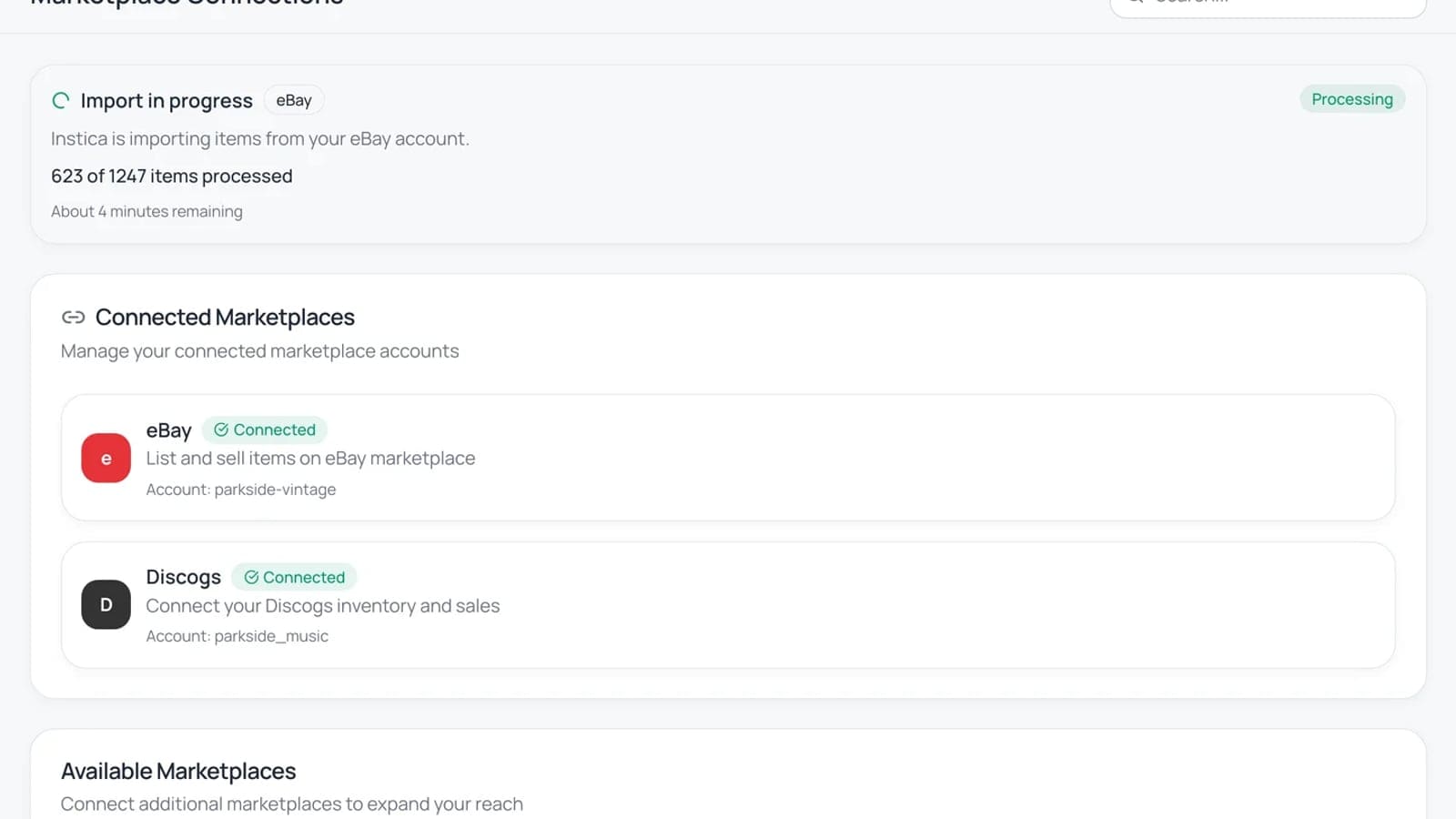
Import once, from your existing listings, into whatever holds your single source of truth — then publish outward to Shopify. The direction matters. Data should flow from your inventory record to the channel, never channel-to-channel. Channel-to-channel copying is how you end up with three slightly different versions of the same product and no way to tell which is authoritative. How that flow works end to end is worth understanding before you start, because reversing it later means redoing the migration.
A few Shopify-specific details that matter for resellers:
SKUs are load-bearing. Shopify uses SKU as the practical join key between your systems. If your marketplace listings don’t have consistent SKUs, fix that before migrating, not after.
Variants are not the same as separate items. For new retail goods, variants (size, color) are correct. For one-of-one resale inventory — a specific used record, a specific vintage jacket — each item is its own product with a quantity of one. Sellers who force unique items into a variant structure lose the ability to track condition and cost per physical object.
Location matters if you have more than one. Shopify tracks inventory by location. If you’re syncing quantity from an external system, make sure it’s writing to the right one, or you’ll get phantom stock.
What This Costs You in Practice
Shopify has a monthly subscription and payment processing fees on each transaction. Marketplaces have no monthly cost but take a substantially larger cut per sale. The crossover point depends on your volume and average order value, and it’s worth actually calculating rather than assuming: run your last three months of sales through both fee structures and see. Our profit margin calculator handles the per-item version of that math.
For most sellers the answer isn’t “switch” — it’s “both.” Marketplaces continue to supply discovery. The storefront captures the repeat buyers who no longer need to discover you, at a much better margin.
The Operational Test
Before you announce your storefront to anyone, run this test: list one item in every channel, sell it in the channel that’s least convenient for you to monitor, and time how long the other channels keep offering it.
If the answer is “until I manually intervene,” you don’t have a multi-channel operation. You have two shops that happen to share a shelf, and the first busy weekend will prove it.
If the answer is measured in seconds, you’re ready to grow — and that’s the configuration where adding a channel actually increases sales rather than adding a new category of apology email. Comparisons with other multi-channel tools are mostly arguments about how well each one holds that invariant under load.
The storefront is worth building. Just build it on top of a single inventory, not next to one.