
Size as a real field
A size run is not one item with a note. Each pair carries its own record, cost and condition, so you can see that the mid-sizes cleared in a week while the extremes are still on the shelf at the original ask.
For Sneaker Resellers
Sneakers are a size-variant business where capital sits on a shelf in boxes, and the number that decides profit is how long each pair waited before it moved.
THE SHAPE OF THE PROBLEM
A sneaker inventory is unusual among reseller categories because the unit is expensive, the variants are numerous, and the value curve is steep and mostly downward after the initial release window. Thirty pairs is not thirty items; it is thirty sizes, several of which are the sizes nobody wanted, bought at the same price as the ones that sold in a day.
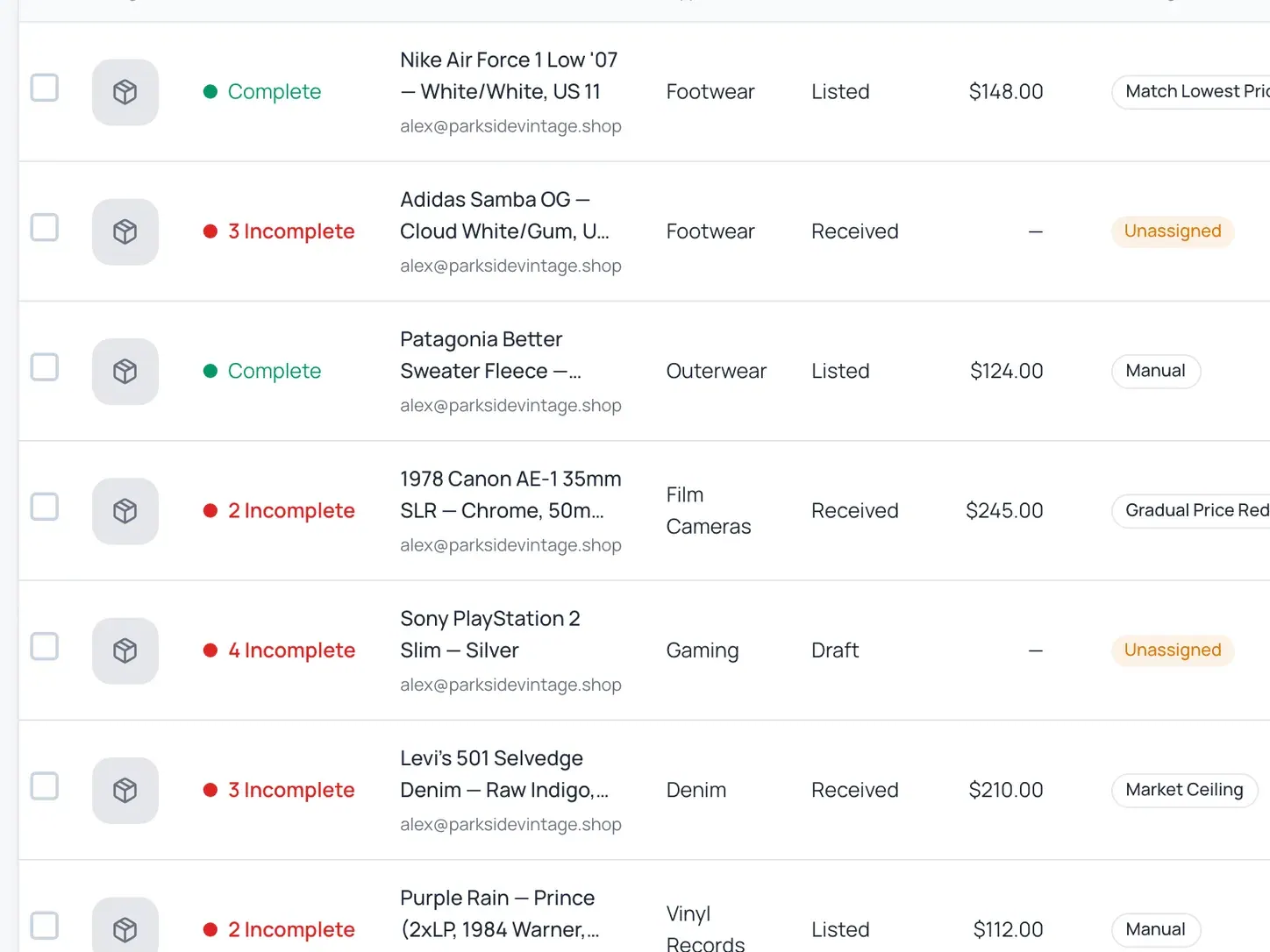
Instica keeps each pair as its own record with its size, its condition, what it cost, and how long it has been sitting. That last field is the one sneaker sellers most often lack and most need, because the difference between a good year and a flat one is usually not the pairs that sold quickly but the ones that did not.
WHAT THE RECORD HOLDS
A size run is not one item with a note. Each pair carries its own record, cost and condition, so you can see that the mid-sizes cleared in a week while the extremes are still on the shelf at the original ask.
Deadstock, near-deadstock, used with box and used without box are all different products to a buyer. Recording which one you actually have prevents the disputes that eat margin on a category where returns are expensive to ship.
Intake date on every record turns holding time into something you can sort by. On a category with this much capital per unit, an ageing view is closer to a cash-flow report than an inventory one.
THE WORKFLOW
Sneaker inventory tends to arrive either as a release-day batch or as a bulk buy of mixed pairs. Both benefit from the same discipline: get the pair-level detail down before the boxes stack up.
Even when ten pairs arrive in one order, create ten records. The moment they become "ten of that shoe" you lose the ability to see which sizes are actually moving.
Box damage, missing lace sets and included extras change the price. Photograph and note them on arrival, because once a box is on a shelf behind others you will not be re-checking it before you list.
Shipping in, any buying fees, and the cost of a pair you had to take as part of a lot all belong in the basis. A pair that looks like a healthy margin on sticker price often is not once the lot maths is honest.
Publish to the channels you sell on and then check the ageing view rather than the listing views. A pair with plenty of views and no sale is a price problem; a pair with neither is a demand problem, and they call for different responses.
CHANNEL BY CHANNEL
Instica connects to eBay and Discogs. Sneaker sellers usually work across more platforms than that, so it is worth being precise about what is and is not covered.
WHERE IT GOES WRONG
Buying a run at one price per pair makes it tempting to treat them as interchangeable. They are not: the sizes that sold at a premium subsidised the ones still sitting, and averaging hides which half of that trade you are actually in.
Capital tied up in unsold pairs is the largest hidden expense in this category, and it never appears on a receipt. Days held is the closest thing to a proxy, which is why it is worth recording intake dates even when it feels like bookkeeping.
Calling a lightly worn pair deadstock wins the sale and loses the return, plus the shipping in both directions and often the fees. Precise condition language on the record is cheaper than a dispute.
FREQUENTLY ASKED
Yes. Treating each pair as its own record is what makes it possible to see which sizes cleared and which are ageing. A single record with a quantity hides exactly the information you need when deciding whether to discount.
No. Instica records what you paid, what you asked, and what it sold for. Resale pricing on footwear moves on release news and demand signals that we do not track, and pretending otherwise would not serve you well.
Instica pushes quantity changes out to the channels it is connected to, which shortens the window in which a sold pair stays listed elsewhere. It does not eliminate it: an outage or two near-simultaneous checkouts can still leave you cancelling on one buyer.
From the reselling course
Every box on the rack is money already spent, and the figure that decides the year is how long each pair waited. Six guides, ordered from the buy to the risk that outlives it.
A size run means one style is really three different bets. Price them separately.
The one risk more likely to close a footwear account than to cost a single sale.
Deadstock, VNDS, worn — stated so a buyer cannot claim they were misled.
Shipping the box as part of the product, because to this buyer it is.
Switched returns and empty-box claims, and the evidence that defends against them.
Once the rack is worth five figures, cover stops being optional.
Free to read — the whole course. If capital feels like the ceiling but you are not certain, spend three minutes on the reseller diagnostic.
Free for 25 items · No card · Cancel from your account page.